Project Gemini at the cape, 1965 to 1966
Ten crewed Gemini missions launched from Cape Kennedy in 21 months. They proved rendezvous, EVA, two-week endurance, and the operational tempo Apollo would need. The cape ran the operations.
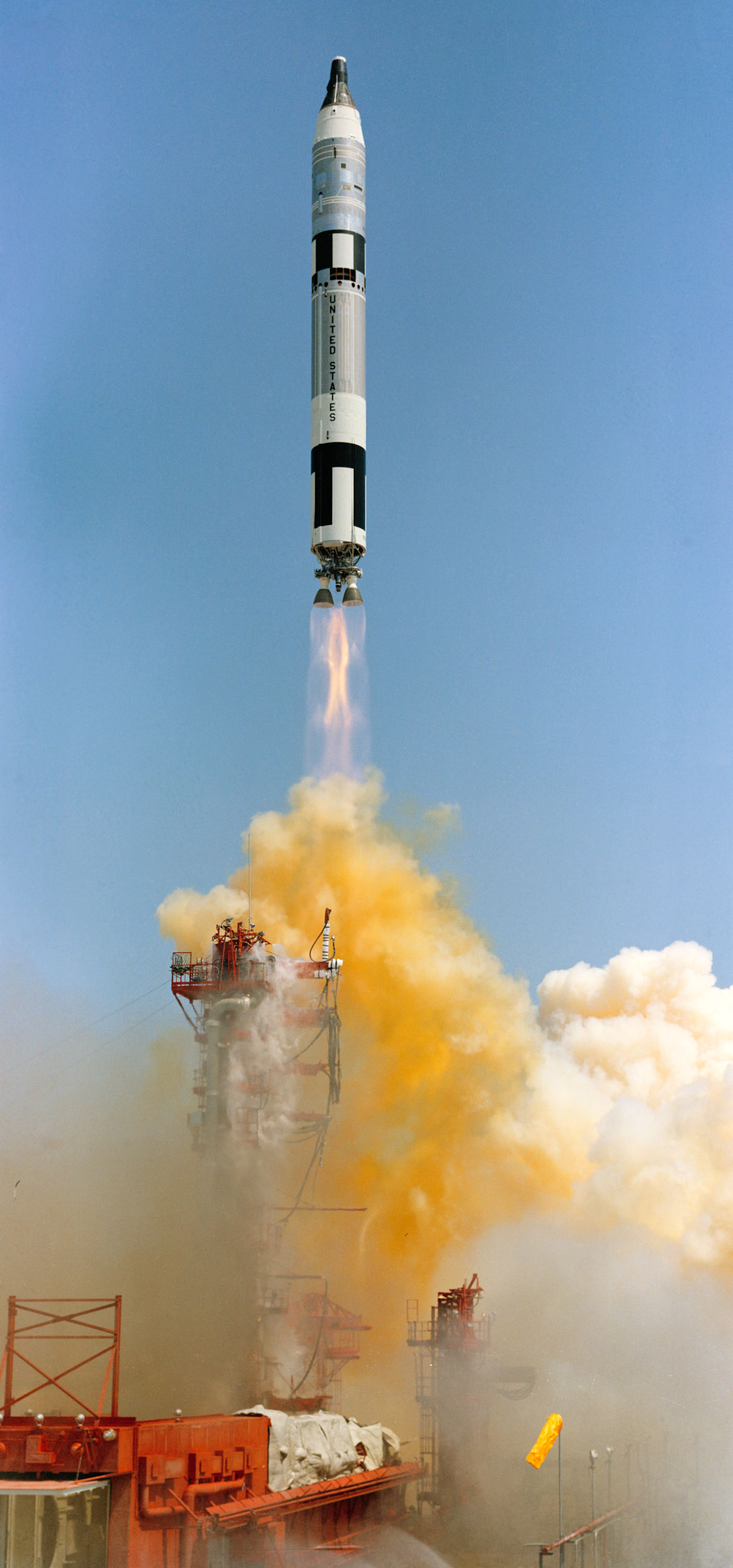
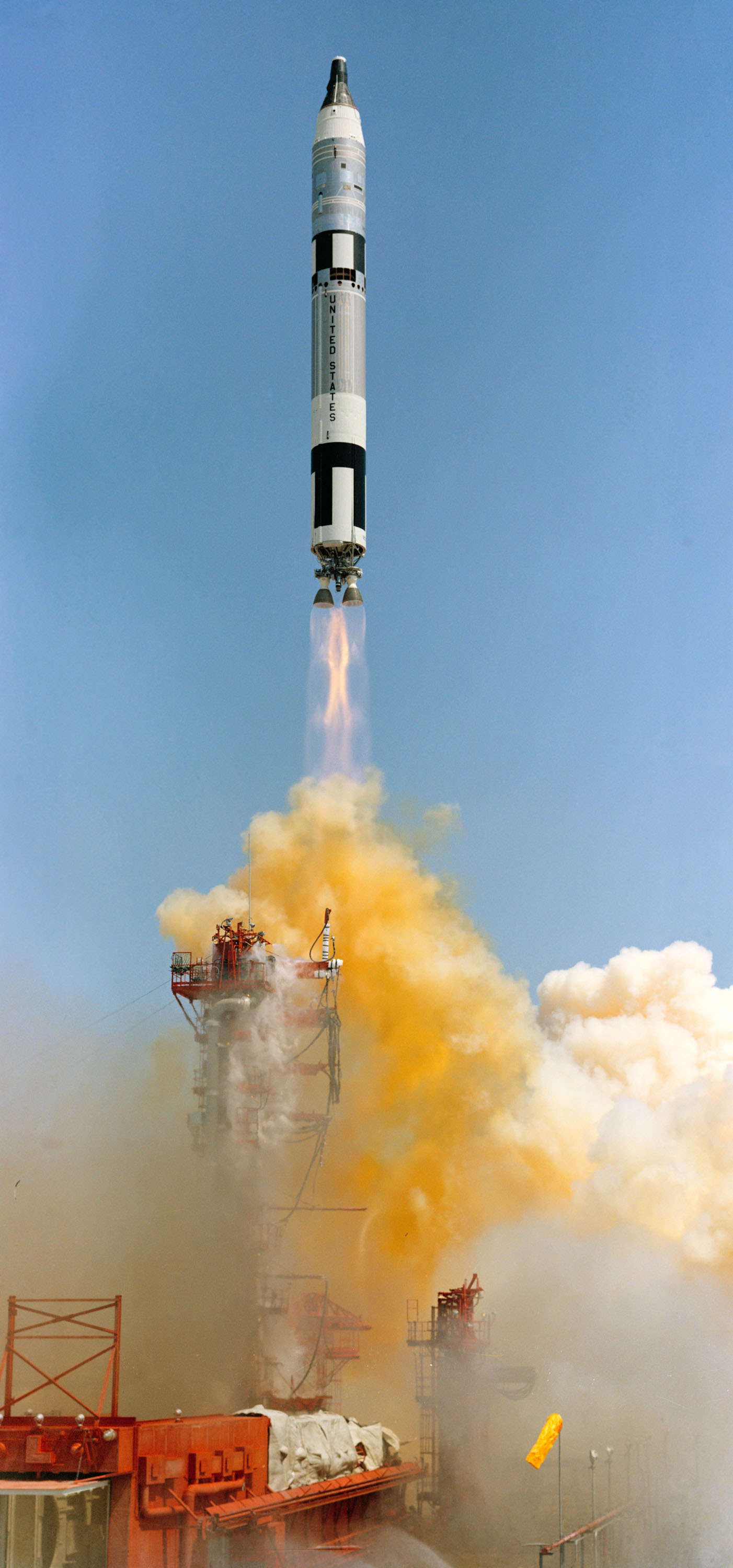
Ten crewed Project Gemini missions launched from Cape Kennedy’s Launch Complex 19 between March 23, 1965, and November 11, 1966. The 21-month sprint proved rendezvous, docking, extravehicular activity, and the 14-day endurance Apollo lunar missions would need. All ten launches used the Titan II booster, a converted ICBM, instead of the Atlas that had carried Mercury. The pace was relentless: Gemini 3 in March 1965, Gemini 12 in November 1966, roughly one mission every two months. The cape ran the operations under Kurt Debus, NASA’s Launch Operations director, with the new Manned Spacecraft Center in Houston handling mission control after liftoff. The cape’s identity locked in during these 21 months. It was no longer the missile range with NASA bolted on. It was the operational launch site for the moon program.
The Gemini concept
NASA conceived Gemini in late 1961 as the bridge between Mercury (single-pilot suborbital and orbital flights) and Apollo (three-pilot lunar missions). The Apollo program would require techniques NASA had never demonstrated: rendezvous of two spacecraft in orbit, docking, extended-duration flight, working outside the spacecraft.
Gemini’s vehicle was a two-pilot capsule, larger than Mercury, designed for rendezvous and docking with an Agena upper-stage target vehicle. The booster was the Titan II, an Air Force ICBM converted to carry the Gemini spacecraft.
The program ran 12 missions total: Gemini 1 and 2 were unmanned engineering flights in 1964. Gemini 3 through 12 were crewed and flew between March 1965 and November 1966.
Launch Complex 19
All ten crewed Gemini missions launched from Launch Complex 19, on the south end of Cape Kennedy Air Force Station. LC-19 had been built in 1959 for the Titan I ICBM testing program and converted for Gemini in 1962. The conversion included a 105-foot service tower, a launch deck, an erector that raised the rocket from horizontal to vertical, and an underground blockhouse 600 feet from the pad.
The pad’s operational tempo through 1965 and 1966 was extraordinary. Titan II vehicles arrived from Martin’s Denver plant by rail. They were assembled horizontally in the LC-19 service hangar, raised vertically by the erector, mated to the Gemini capsule, and launched. The turnaround was typically 60 to 90 days between missions.
LC-19 was deactivated after Gemini 12 in November 1966. The Air Force tried to repurpose it for the Manned Orbiting Laboratory program, which was cancelled in 1969. The launch tower stood derelict through the 1970s and was finally demolished in 1977. The launch deck and blockhouse remain on the cape, partially visible from the official tour route.

The ten missions
Gemini 3 (March 23, 1965): Gus Grissom and John Young. Three orbits. First crewed Gemini flight. Young smuggled a corned beef sandwich aboard.
Gemini 4 (June 3, 1965): Jim McDivitt and Ed White. Four days, 62 orbits. White performed the first US spacewalk on the third orbit, 20 minutes outside the capsule, attached by a tether and using a hand-held maneuvering unit.
Gemini 5 (August 21, 1965): Gordon Cooper and Pete Conrad. Eight days, 120 orbits. Endurance record.
Gemini 6A (December 15, 1965): Wally Schirra and Tom Stafford. Two days. First space rendezvous with Gemini 7, approaching within 30 cm of the other craft.
Gemini 7 (December 4, 1965): Frank Borman and Jim Lovell. Fourteen days, 206 orbits. Longest US flight to date and the rendezvous target for Gemini 6A.
Gemini 8 (March 16, 1966): Neil Armstrong and David Scott. First docking with an Agena target. A stuck thruster sent the docked stack into an uncontrolled 60-rpm roll. Armstrong undocked, fired the reentry control thrusters to recover, and made an emergency reentry into the Pacific 11 hours after launch. NASA’s first abort of a crewed mission.
Gemini 9A (June 3, 1966): Tom Stafford and Gene Cernan. Three days. The Agena target had failed during launch, so NASA flew a backup target (the “Augmented Target Docking Adapter”) that had a shroud stuck open. The cape press corps called it the “angry alligator.”
Gemini 10 (July 18, 1966): John Young and Michael Collins. Three days. First mission to dock with one Agena, undock, and rendezvous with a different (Gemini 8’s old) Agena.
Gemini 11 (September 12, 1966): Pete Conrad and Dick Gordon. Three days. Reached an altitude of 850 miles, the highest crewed orbital flight to that date.
Gemini 12 (November 11, 1966): Jim Lovell and Buzz Aldrin. Four days. Aldrin performed three EVAs totaling 5 hours 30 minutes, solving the spacewalk-difficulty problems that had plagued earlier Gemini missions.
What Gemini gave Apollo
By the end of Gemini 12, NASA had demonstrated:
- Rendezvous and docking (twice with active Agenas, plus emergency rendezvous techniques)
- EVA up to 5 hours, with controlled workload management
- Fourteen-day duration spaceflight
- Precision reentry within sight of the recovery carrier
- Rapid pad turnaround (LC-19’s 1965-1966 cadence)
Every one of those capabilities was required for Apollo. None of them had been demonstrated by anyone in 1962. The Soviets, despite having flown earlier orbital missions, had not done rendezvous in this period, had not done useful EVA, and had not flown crewed for longer than five days.
Apollo would have been impossible without Gemini’s 21-month proof-of-concept run. The Apollo program team studied every Gemini flight in granular detail and translated the results into Apollo operating procedures.
What Gemini cost
NASA’s January 1969 congressional report itemized the full Gemini program at $1.2834 billion in then-year dollars. The breakdown: $797.4 million for the spacecraft, $409.8 million for the launch vehicles, $76.2 million for support and operations. In 2024 dollars that total runs to roughly $9.3 billion. Spread across ten crewed missions in 21 months, the per-mission cost averaged about $128 million in 1967 dollars.
By comparison, Mercury cost $277 million for six crewed missions, and Apollo would cost $25.4 billion through Apollo 17. Gemini sat in the middle: more expensive per mission than Mercury because of the rendezvous hardware and two-pilot capsule, but a fraction of Apollo’s outlay. The program was managed by NASA’s Manned Spacecraft Center in Houston, with launch operations under Kurt Debus at the cape and vehicle integration handled at McDonnell Aircraft in St. Louis. The Titan II was procured under a transfer agreement with the Air Force, which built the missile at the Martin Company’s Denver plant for both ICBM and Gemini use.
The Agena failures that almost stopped the program
The Agena Target Vehicle was Gemini’s rendezvous and docking partner. Lockheed built it as an upper stage adapted from an Air Force satellite booster. Of the six Agenas launched for Gemini missions, two failed outright before reaching orbit: the Agena for Gemini 6 in October 1965 exploded six minutes after launch, forcing the Gemini 6A re-manifest that used Gemini 7 as the rendezvous target. The Agena for Gemini 9 also failed at launch in May 1966, requiring NASA to fly an Augmented Target Docking Adapter that arrived at orbit with a payload shroud jammed open.
The Agena problems contributed to the death of Elliott See and Charles Bassett, the original Gemini 9 prime crew, in a February 28, 1966 T-38 trainer crash at McDonnell’s St. Louis facility. They had been there for Agena fit checks against a delayed launch schedule. The backup crew of Tom Stafford and Gene Cernan took the mission. The Agena’s reliability did not reach acceptable levels until late 1966, by which point Gemini was nearly over.
The cape’s tempo
For the cape itself, Gemini was the operational test. The launch site supported a mission roughly every two months for 18 months. The local economy adapted: Cocoa Beach hotels stayed full year-round, restaurants ran 24-hour schedules, the Air Force support facilities at Patrick AFB grew steadily.
The Apollo program would scale this further, with the Saturn V pads at LC-39A and LC-39B on Merritt Island. But the Gemini era at LC-19 was when the cape’s operational rhythm got established. The patterns that ran the Apollo program (the daily standup, the launch-readiness review, the press tour, the recovery deployment) came from Gemini.
After Gemini 12, LC-19 stood empty. The cape moved north to Merritt Island and got bigger. The Gemini-era south cape became the historical pad cluster, gradually demilitarized except for security perimeters and the lighthouse. The infrastructure had served its purpose.
Further Reading
As an Amazon Associate we earn from qualifying purchases.