Apollo 1 and Launch Complex 34 : January 27, 1967
The Apollo 1 pad fire killed Gus Grissom, Ed White, and Roger Chaffee on the cape on January 27, 1967. The launch complex is now a national memorial. The accident reshaped the entire Apollo program.
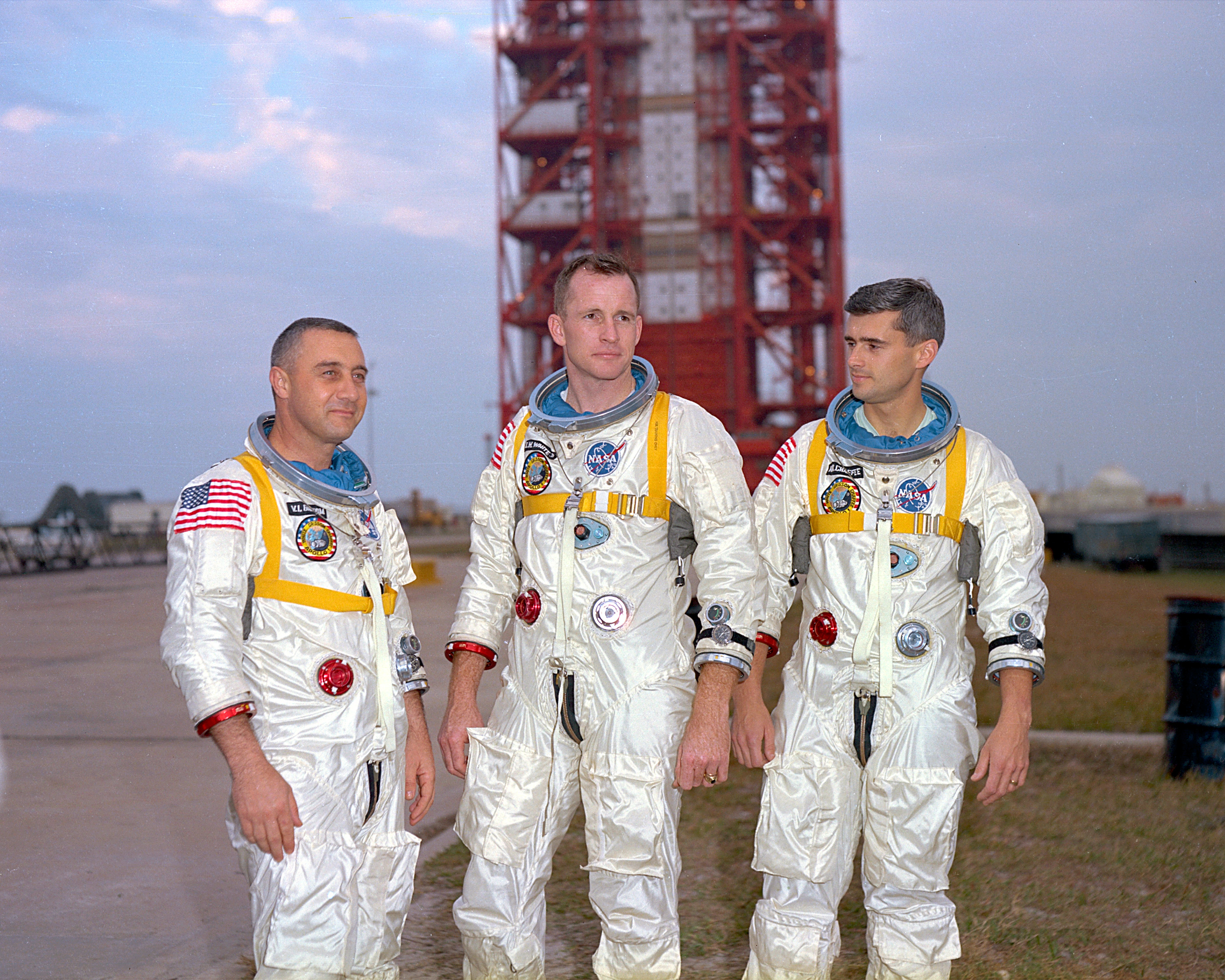
Apollo 1’s crew, Virgil “Gus” Grissom, Edward White, and Roger Chaffee, died in a pad fire at Launch Complex 34 on Cape Canaveral Air Force Station on January 27, 1967, at approximately 6:31 PM EST. The crew were inside the Apollo command module during a launch-rehearsal test when an electrical short ignited the pure-oxygen atmosphere. The fire spread in 17 seconds. The inward-opening hatch could not be opened from inside in time. The accident shut down the Apollo program for 21 months. NASA redesigned the command module: outward-opening hatch, fire-resistant materials, mixed-gas pre-launch atmosphere. LC-34 was used for two more launches (Apollo 5 unmanned in January 1968, Apollo 7 crewed in October 1968) before being retired. The pad’s remains are now a National Historic Landmark and Apollo 1 memorial.
What happened on January 27
Apollo 1, officially designated Apollo Saturn 204, was the first scheduled crewed Apollo mission. The launch had been scheduled for February 21, 1967. On January 27, the crew was conducting a launch-rehearsal test called the “plugs-out” test: a full simulation of the launch sequence with the command module sealed and powered on internal systems.
The test began at 1:00 PM EST. Multiple technical issues delayed progress through the afternoon. At 6:31 PM, with the crew sealed inside the command module, a flash fire ignited in the spacecraft. The crew’s last communications, captured on the test audio recording, were Chaffee saying “fire, I smell fire” followed by White: “Fire in the cockpit.”
The fire spread through the command module in approximately 17 seconds. The cabin pressure rose rapidly due to the heating, then the cabin failed structurally. The cabin atmosphere, pure oxygen at slightly above sea-level pressure, supported combustion of materials that would not burn in normal air.
The crew were dead within 30 seconds of the fire’s start. The cause of death was carbon monoxide inhalation, with severe burns post-mortem.
What caused the fire
The Apollo 204 Review Board’s investigation, conducted between January 28 and April 5, 1967, identified the most likely ignition source as an electrical arc near the floor of the command module, on the wiring that ran to the environmental control unit. The arc occurred in a damaged wire bundle that had been chafed by repeated maintenance operations.
The fire spread because of three engineering decisions:
- The cabin atmosphere was pure oxygen at 16.7 psia (slightly above sea-level pressure). This was chosen to simplify the spacecraft’s life-support systems by avoiding the complexity of mixed gas at altitude. Pure oxygen at this pressure makes most materials flammable.
- The cabin contained substantial flammable material: nylon netting, plastic switches, Velcro fasteners, paper checklists, and crew flight suits. These materials would not burn under normal conditions but burned readily in the pure oxygen atmosphere.
- The hatch opened inward, and required about 90 seconds to unlatch from inside under normal conditions. The crew did not have 90 seconds.
The combination of pure oxygen, flammable interior, and inward-opening hatch was lethal. Removing any one of these factors would likely have allowed the crew to survive.
The 21-month gap
NASA grounded the Apollo program for 21 months while the command module was redesigned. The redesign included:
- An outward-opening hatch with quick-release latches (about 7 seconds to open from inside)
- Replacement of all flammable cabin materials with fire-resistant alternatives
- A mixed-gas pre-launch atmosphere (60 percent oxygen, 40 percent nitrogen at sea-level pressure, transitioning to pure oxygen at altitude when pressure dropped to about 5 psia)
- Improved wiring with better insulation and chafe protection
- Pre-launch fire suppression systems
The redesigned command module first flew in October 1968 on Apollo 7, a low Earth orbit shakedown mission. The mission was successful. Subsequent Apollo flights (Apollo 8 through Apollo 17) used the redesigned vehicle. No further command module fires occurred.
LC-34’s status
Launch Complex 34 was used for two more flights after Apollo 1:
- Apollo 5 (uncrewed, January 22, 1968): Tested the Apollo lunar module on a Saturn 1B
- Apollo 7 (crewed, October 11, 1968): The first crewed Apollo flight after the fire
After Apollo 7, NASA shifted Apollo operations to Launch Complex 39 at Kennedy Space Center on Merritt Island, which had larger pads built specifically for the Saturn V vehicle. LC-34 was retired in 1969.
Most of LC-34’s structures were demolished in the 1970s and 1980s. The launch pedestal (the concrete base on which the Saturn IB had stood) remains. So does the blockhouse. So does some of the pad infrastructure.
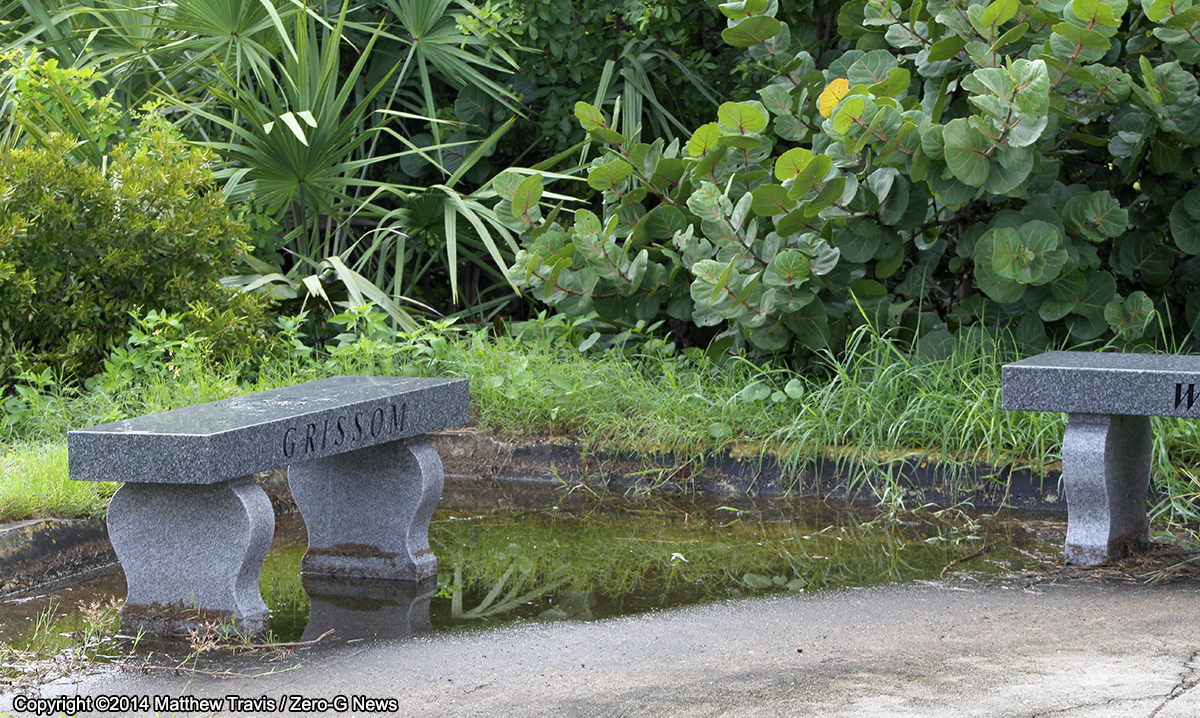
The site was designated as part of the Cape Canaveral Air Force Station National Historic Landmark in 1984. In 2008, NASA and the Air Force installed permanent memorial plaques at the launch pedestal commemorating the Apollo 1 crew.
The memorial site is accessible only via official tour. Tours are arranged through the Kennedy Space Center Visitor Complex and require advance reservation. The tour visits the LC-34 site for approximately 15 minutes, with a short speech and silent reflection. Most participants find it deeply moving.
What the accident meant
Three things, lasting.
First, the Apollo program was permanently affected. The 21-month delay slowed the moon-landing schedule. The vehicle redesign added cost and complexity. The crew loss had personal effects on the surviving Apollo astronaut corps that lasted for decades. The accident is, in some sense, what the agency learned from rather than what it avoided. NASA today still references Apollo 1 as the cautionary case for organizational complacency.
Second, the lessons applied beyond Apollo. The mixed-gas atmosphere, the outward-opening hatches, the flammability restrictions, the pre-launch fire suppression are all standard in spacecraft design now. The Shuttle, the Crew Dragon, the Starliner, the Orion command module all incorporate Apollo 1 lessons. Other space programs (Russian Soyuz, European Hermes, Chinese Shenzhou) also incorporate these lessons.
Third, the cape’s specific identity changed. Apollo 1 happened on Cape Canaveral Air Force Station, not at NASA’s Kennedy Space Center. The fire happened on the cape, not on Merritt Island. The cape’s residential community (Cocoa Beach, Cape Canaveral the city) watched the fire from less than 10 miles away. The cape’s identity as a place where launch tragedy could happen was established in 1967, 19 years before Challenger and 36 years before Columbia.
The memorial
The Apollo 1 memorial at LC-34 is one of the cape’s three irreplaceable historic features (along with the lighthouse and the two pre-1949 cemeteries). It is the place where:
- Three astronauts died in service to the Apollo program
- NASA’s organizational confidence was permanently complicated
- The Apollo program’s hardware was substantively redesigned
The memorial is also the place where, on every anniversary (January 27), the agency, the Air Force, and the cape’s local community come together in a small ceremony. The ceremony includes:
- The reading of the crew’s names
- The presentation of three white roses (one for each crew member)
- A moment of silence at 6:31 PM EST (the time of the fire)
- A brief speech, typically by a NASA administrator or astronaut
The ceremony is private. Only invited guests attend. But it has continued every year since 1968.
What we should remember
The Apollo 1 crew were:
Virgil “Gus” Grissom: born March 5, 1926, died at age 40. One of the original Mercury Seven astronauts. Flew Mercury MR-4 (Liberty Bell 7) in July 1961 and Gemini 3 (Molly Brown) in March 1965. Was widely considered the most senior Apollo astronaut and a likely commander for the first lunar landing.
Edward White: born November 14, 1930, died at age 36. Flew Gemini 4 in June 1965 and performed the first US spacewalk. A West Point graduate and Air Force pilot.
Roger Chaffee: born February 15, 1935, died at age 31. Naval aviator. Apollo 1 was scheduled to be his first spaceflight. He had been on track to become one of the youngest Apollo astronauts.
The three were buried with full military honors. Grissom and Chaffee are interred at Arlington National Cemetery. White is buried at the West Point Cemetery.
Their names appear on every NASA astronaut memorial. They appear at the Astronaut Memorial at Kennedy Space Center. They appear at the Apollo 1 memorial at LC-34. They appear in every Apollo history. Their names should be in every account of the cape’s Apollo era.
The launches resumed. The moon landing happened. The cape continued. But Apollo 1 is the cape’s first reminder, in the launches’ own terms, that the work is dangerous and that the people are not abstract.
Further Reading
As an Amazon Associate we earn from qualifying purchases.